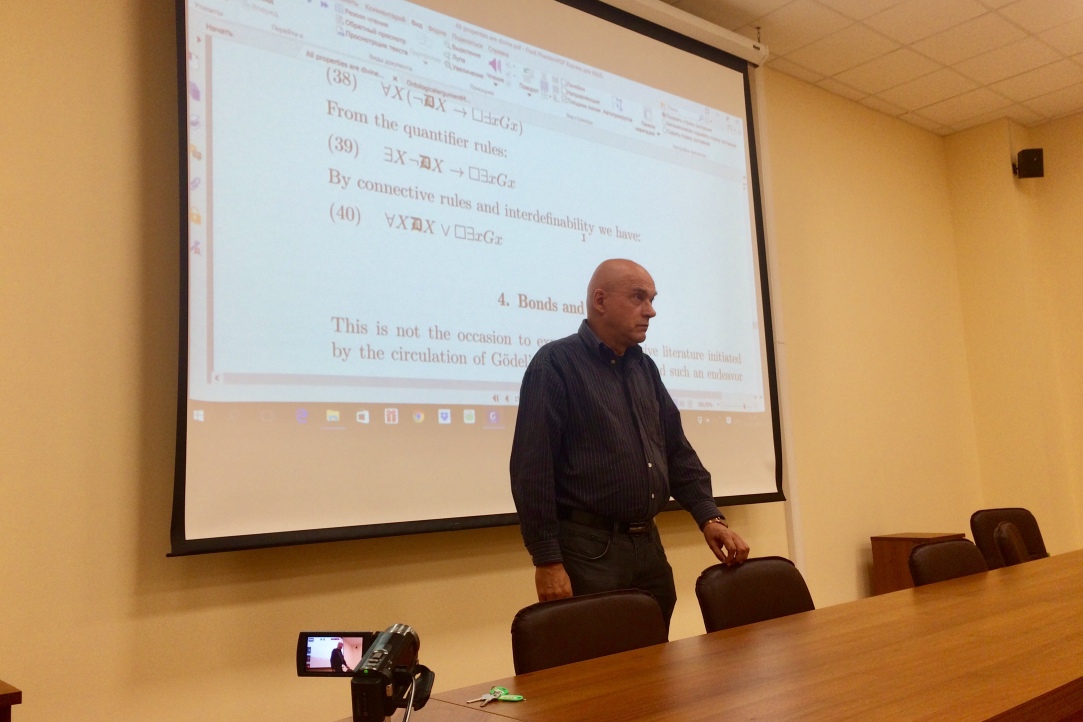
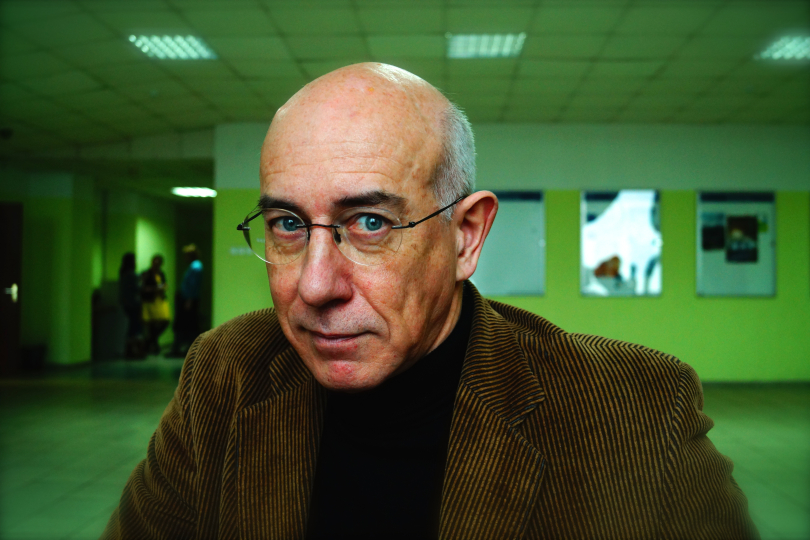
On October 16th Frode Alfson Bjørdal (professor emeritus at The University of Oslo) presented a talk "All Properties are Divine or God exists" at the joint meeting of Logico-philosophical club and Formal philosophy group (HSE)
On October 10, Stephen Wheatcroft, Professor of the School of Historical Studies at the University of Melbourne delivered a lecture on ‘The importance of the grain problem in the Russian Revolution and for the next 40 years of Soviet Economics' at HSE Moscow as part of a long and busy schedule. A participant at previous April Conferences at HSE, Professor Wheatcroft is one of the world’s foremost experts on Soviet social, economic and demographic history, as well as famine and food supply problems in modern world history.
On May 31, Valerie Kivelson, Professor of History at the University of Michigan, will be delivering a seminar entitled ‘Visualizing Empire: Muscovite Images of Race’. Professor Kivelson is an expert in Medieval and early modern Russia, history of cartography, history of witchcraft, religion, and political culture, among other topics. She is the author of 'Desperate Magic: The Moral Economy of Witchcraft in Seventeenth Century Russia' and a guest editor of 'Witchcraft Casebook: Magic in Russia, Poland and Ukraine. 15-21st Centuries'.
On May 23, Ellen Rutten, Professor of Russian and Slavic Studies at the University of Amsterdam, delivered a lecture at HSE on her new book, ‘Sincerity after Communism’. An expert on Slavonic literature and culture, Professor Rutten is involved in numerous projects, including the Digital Emotions group, Sublime Imperfections, and ‘Russian Literature’, a journal where she serves as editor-in-chief.
Dirk Geeraerts, a professor at the University of Leuven, talks about the advantages of linguistiс training at the Higher School of Econimics, the high level of interaction demonstrated by the students at the School of Linguistics, and the potential upcoming convergence of fundamental and applied linguistic research.
Tilmann Reuther, Professor at the University of Klagenfurt, and his colleague Joulia Köstenbaumer talk to the HSE News Service about their experience of cooperation with the School of Linguistics and internships in Austria.
On October 21, the HSE Poletayev Institute for Theoretical and Historical Studies in the Humanities hosted a lecture entitled ‘Classics in the Modern Age: Online Opera Fans Battle for the Enigmatic Russian Soul’. Delivered by Emily Erken, Lecturer of Musicology at The Ohio State University’s School of Music, her lecture covered the peculiarities of Runet contributors in their reactions to contemporary productions of classic operas. Among other topics, her lecture addressed how Russians today are seeking to rethink the moral identity of the country in which they live and how representatives from a number of cultural groups present their current views as a natural development of the national heritage.