From September 23 to October 2, the HSE School of Philology (Faculty of Humanities) will host Susanna Witt, Associate Professor, Senior Research Fellow, Uppsala Centre for Russian and Eurasian Studies, Uppsala University (Sweden). During this time she will lecture at a conference on World Literature as a Soviet Project, as well as teach several lectures in the School of Philology.
What causes variation between languages, and what do they have in common? How is language embedded in our general cognitive system? These are some of the questions that Eric Reuland, Faculty Professor of Language and Cognition at the Utrecht Institute of Linguistics (OTS) (Utrecht University), will address in a lecture course entitled ‘Syntactic approaches to anaphora’ that will be held at HSE Moscow from September 12 till 22, 2016. Professor Reuland recently spoke with the HSE news service about his research interests, his upcoming visit to Moscow, and some books he recommends for those interested in gaining exposure to the field of linguistics.
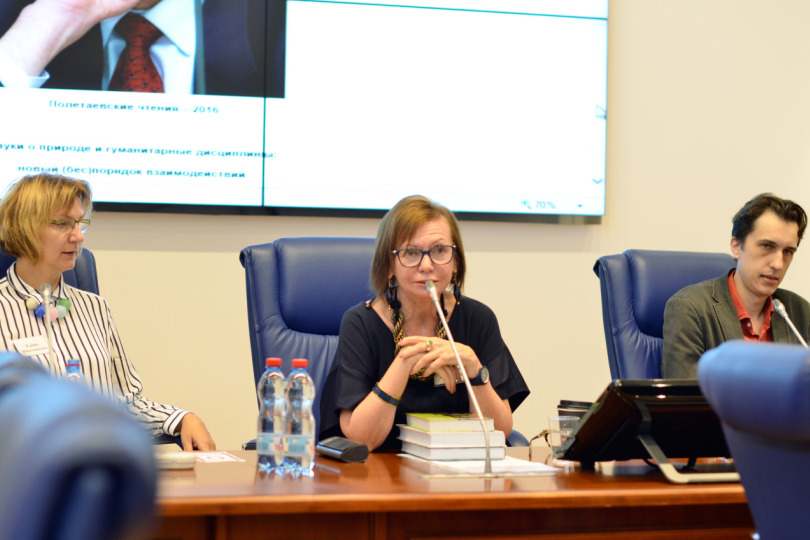
On September 9, 2016, VI Poletayev Memorial Readings entitled "Natual Sciences and Humanities: New Interaction (Dis)Order" were held at the Higher School of Economics. Among the participants were two guest speakers: Karl Hall from Central European University (Budapest) and Kornelius Borck from Lübeck University (Lübeck).
A meeting as part of the cultural exchange between HSE’s Humanities Faculty, the RAS Institute of Philosophy and the Amalfi Center of History and Culture took place on September 2-3.
The first Moscow-Tartu School in Digital Humanities has taken place at the Leo Tolstoy House and Museum in Yasnaya Polyana. The school‘s aim is to create an interdisciplinary academic environment in which modern computer methods are applied to the study of texts. The school was organized by the HSE School of Linguistics, Leo Tolstoy House and Museum in Yasnaya Polyana, and the Department of Russian Literature at the University of Tartu.
A new English-taught master’s programme ‘Linguistic Theory and Language Description’ starts in the new academic year. Ekaterina Rakhilina, Head of the School of Linguistics, told us about some details of the programme, project work and the potential for international cooperation.
During the annual road expedition 'Cultural Effects of Borders', culture studies students from HSE visited Georgia, Armenia, and – for the first time – Iran. They talked to HSE News about the tastes and colors of Iran, and about how compliments form the foundation of the country's communications culture.
Professor Peter Anstey from the University of Sydney held a series of seminars on research methods in the humanities and early modern philosophy at HSE Moscow last week. The seminars were connected to his project ‘The Nature and Status of Principles in Early Modern Philosophy’. How have the studies of philosophy evolved? What is the role of philosophy of the modern world? How can Russian students become involved in global research projects? These were some of the issues Peter Anstey talked about with HSE News Service.
This year, many students and staff of HSE in Moscow will change the location of their study and work. Instead of some sites in districts on the outskirts of the sity, the university is using buildings in the centre. In addition to that, faculty departments which are now scattered in various parts of the city will move closer to each other. This will allow lecturers and students to spend less time commuting.