News
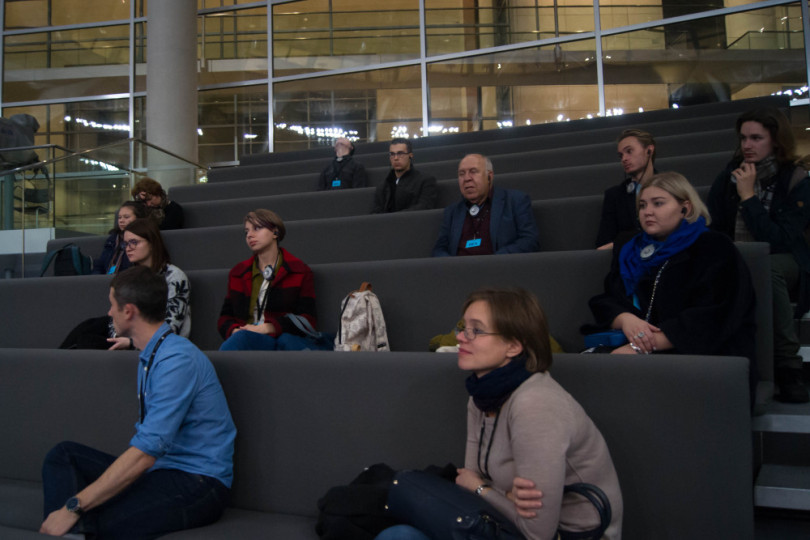
From October 7 - November 12, 2016 a school for undergraduate, graduate and doctoral students organized by the International Centre for the History and Sociology of World War II and Its Consequences was held in Germany. The school was dedicated to issues of memorialization and commemorating victims of terror and was led by the Centre’s Director Oleg Budnitskii. The trip was organized with the support of the Friedrich Ebert Foundation.
This year HSE has launched a new English-taught MA programme ‘Linguistic Theory and Language Description’, which has evolved from a specialization on the Computer Linguistics programme. Michael Daniel, one of the programme’s Academic Supervisors, told the HSE news service about the multilingual people who will study here, the expeditions the students will go on, and other features of the programme.
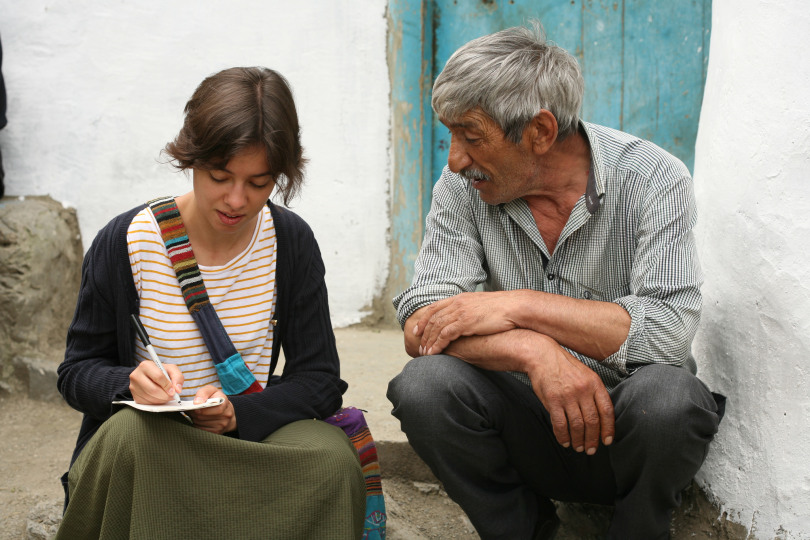
Is it possible to learn a new language well enough in just two weeks to conduct linguistic research on it? This is an entirely standard practice for linguists, according to Sasha Kozhukhar and Liza Vostokova, both students in the Linguistic Theory and Language Description master’s programme. This past summer, Sasha and Liza went on an expedition to Guatemala to study Kaqchikel, an indigenous Mayan language.
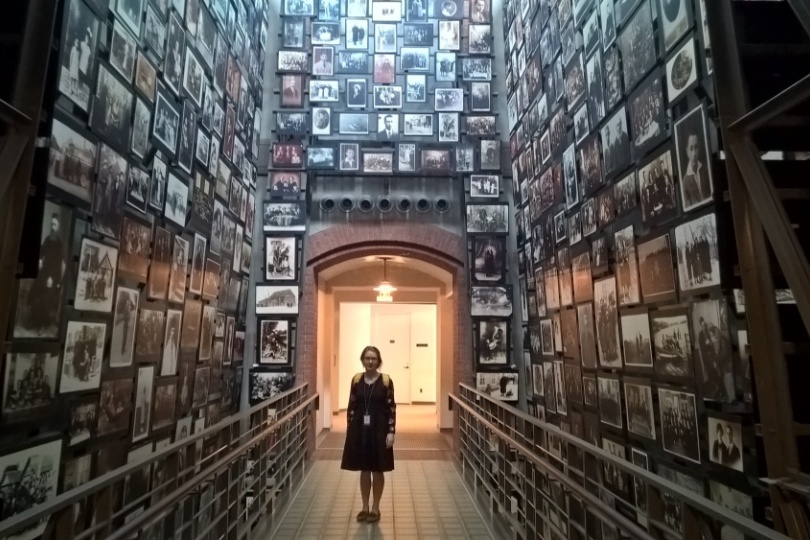
Yanina Karpenkina won the 2016 annual contest for HSE students, which is organized by the International Centre for the History and Sociology of World War II and Its Consequences. Thanks to the contest, she went on a six-week internship as a research assistant with the Jack, Joseph and Morton Mandel Center for Advanced Holocaust Studies at the United States Holocaust Memorial Museum.
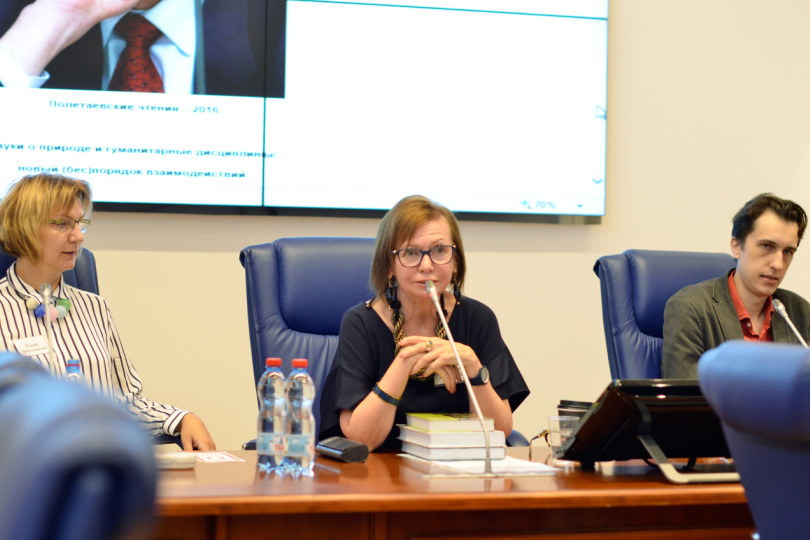
On September 9, 2016, VI Poletayev Memorial Readings entitled "Natual Sciences and Humanities: New Interaction (Dis)Order" were held at the Higher School of Economics. Among the participants were two guest speakers: Karl Hall from Central European University (Budapest) and Kornelius Borck from Lübeck University (Lübeck).
From September 23 to October 2, the HSE School of Philology (Faculty of Humanities) will host Susanna Witt, Associate Professor, Senior Research Fellow, Uppsala Centre for Russian and Eurasian Studies, Uppsala University (Sweden). During this time she will lecture at a conference on World Literature as a Soviet Project, as well as teach several lectures in the School of Philology.
What causes variation between languages, and what do they have in common? How is language embedded in our general cognitive system? These are some of the questions that Eric Reuland, Faculty Professor of Language and Cognition at the Utrecht Institute of Linguistics (OTS) (Utrecht University), will address in a lecture course entitled ‘Syntactic approaches to anaphora’ that will be held at HSE Moscow from September 12 till 22, 2016. Professor Reuland recently spoke with the HSE news service about his research interests, his upcoming visit to Moscow, and some books he recommends for those interested in gaining exposure to the field of linguistics.
On September 9, 2016, VI Poletayev Memorial Readings entitled "Natual Sciences and Humanities: New Interaction (Dis)Order" were held at the Higher School of Economics. Among the participants were two guest speakers: Karl Hall from Central European University (Budapest) and Kornelius Borck from Lübeck University (Lübeck).
A meeting as part of the cultural exchange between HSE’s Humanities Faculty, the RAS Institute of Philosophy and the Amalfi Center of History and Culture took place on September 2-3.
Higher School of Economics (HSE) moved from the 501-550 to the 411-420 group on the QS World University Ranking for 2016/17.
The first Moscow-Tartu School in Digital Humanities has taken place at the Leo Tolstoy House and Museum in Yasnaya Polyana. The school‘s aim is to create an interdisciplinary academic environment in which modern computer methods are applied to the study of texts. The school was organized by the HSE School of Linguistics, Leo Tolstoy House and Museum in Yasnaya Polyana, and the Department of Russian Literature at the University of Tartu.
A new English-taught master’s programme ‘Linguistic Theory and Language Description’ starts in the new academic year. Ekaterina Rakhilina, Head of the School of Linguistics, told us about some details of the programme, project work and the potential for international cooperation.
During the annual road expedition 'Cultural Effects of Borders', culture studies students from HSE visited Georgia, Armenia, and – for the first time – Iran. They talked to HSE News about the tastes and colors of Iran, and about how compliments form the foundation of the country's communications culture.
Professor Peter Anstey from the University of Sydney held a series of seminars on research methods in the humanities and early modern philosophy at HSE Moscow last week. The seminars were connected to his project ‘The Nature and Status of Principles in Early Modern Philosophy’. How have the studies of philosophy evolved? What is the role of philosophy of the modern world? How can Russian students become involved in global research projects? These were some of the issues Peter Anstey talked about with HSE News Service.
This year, many students and staff of HSE in Moscow will change the location of their study and work. Instead of some sites in districts on the outskirts of the sity, the university is using buildings in the centre. In addition to that, faculty departments which are now scattered in various parts of the city will move closer to each other. This will allow lecturers and students to spend less time commuting.
From November 14 - 24th a series of lectures on 'Diversity and Uniformity in Linguistic Sound Systems' by Ian Maddieson, Adjunct Research Professor at the University of New Mexico, Adjunct Professor Emeritus at the University of California was held at the HSE School of Linguistics. The course was dedicated to the phonetic diversity of languages and included eight lectures. During the series, Professor Maddieson talked to HSE English News Editor, Anna Chernyakhovskaya’s questions about his research into the relations between language and environment.
Honorary Professor at the University of Chicago and Sydney University, historian Sheila Fitzpatrick gave a lecture on Stalin and Post-War Anti-Semitism in the USSR at the HSE’s International Center for the History and Sociology of World War II and Its Consequences on Thursday 22nd October. In her talk, Professor Fitzpatrick looks at anti-semitism as a bone of contention between Stalin and his closest colleagues in the years when challenging the leader could have life-threatening consequence. As she explained in an interview with the HSE English News website, Sheila Fitzpatrick’s interest in the ‘Jewish question’ came out of her latest book.
On October 15-21, the second Italy-Russia cultural exchange meeting took place at Amalfi. Devoted to art and spirituality, the event drew the participation of staff members from the HSE Faculty of Humanities. During the meeting a book on the Russian footprint in Amalfi’s history was presented.
Challenging traditional explanations of history and taking a new view on the past is the hallmark of a good historian; re-examining the history of post-war Soviet agriculture and economics is no exception, according to Aaron Hale-Dorrell, who recently received his PhD in History from the University of North Carolina – Chapel Hill and will begin a post-doctoral fellowship at the HSE International Centre for the History and Sociology of World War II and Its Consequences in September. Aaron Hale-Dorrell recently agreed to speak with the HSE news service about his research interests, his plans while at HSE, and his experiences living and working in Russia.