News
A numerous delegation of Center for Language and Brain (Neurolinguistics Lab) members led by the head of the Lab attended the annual Science of Aphasia Conference 2017 in Geneva, Switzerland.
On September 1, 2017, Sean Winkler joined the School of Philosophy as a research fellow for one year. Originally from Chino Hills, California, he holds an undergraduate and Master’s degree in philosophy from Loyola Marymount University (Los Angeles, California), as well as a Master’s degree and PhD from KU Leuven (Leuven, Belgium).
Ever since she completed her dissertation on ‘The role of the Ecclesiastical Academies in Reception of Kantianism in the Russian Empire’ in 2015, Vera Pozzi, a native of the northern Italian city of Lecco, has sought an opportunity to return to Russia to take her research to the next level. When she saw HSE’s call for international fellowships, she was drawn by the internationally oriented nature of the application and the opportunity to apply for a field like ‘History of Russian Intellectual Culture’, which aligns perfectly with her current research interests. In September, Vera will be enrolled in the Faculty of Humanities, School of Philosophy for one year under a post-doc fellowship.
One of HSE’s newest faculty members is Francis Tyers, who will join the School of Linguistics on August 28 as an Assistant Professor. A native of Normanton on Soar, a small village in the south of Nottinghamshire in England, he joins HSE following a postdoctoral fellowship at UiT Norgga árktalaš universitehta in Tromsø in the north of Norway, where he worked on language technology for Russian and the Sámi languages. Prior to that, he completed PhD studies in the Department of Languages and Information Systems at the Universitat d'Alacant in Spain.
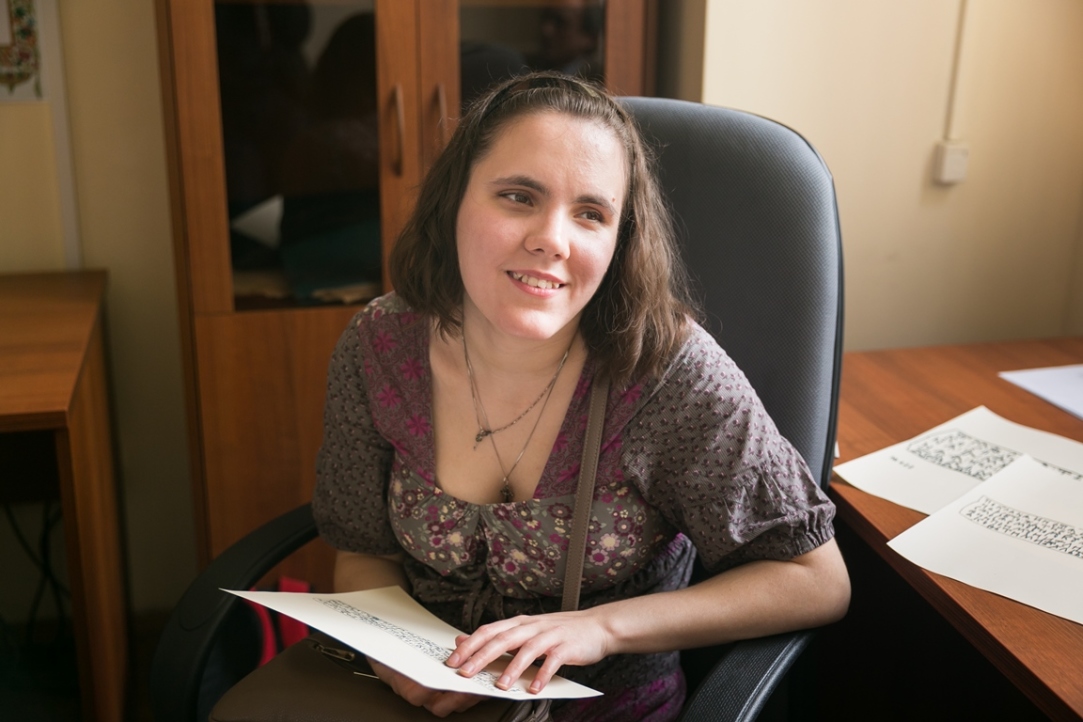
Oksana Osadchaya, a blind sophomore in the undergraduate philology programme, has developed a version of braille for Old Russian texts. Oksana recently defended her thesis on the subject. Together with her academic advisor Alexey Gippius, Oksana met with the HSE News Service to discuss her work, as well as the opportunities that she has opened up for blind researchers who study texts in Old Russian, Old Slavonic, and Old Church Slavonic.
The HSE School of Cultural Studies has designed a museum dedicated to the Soviet-era apartment complexes called Khrushchyovka buildings. The plans of the museum were presented at a meeting held by the Russian Ministry of Culture in Tsarskoye Selo. Under the guidance of cultural studies Associate Professor Irina Gluschenko, undergraduate and post-graduate students began working on the project long before the topic of citywide building renovation became part of public discussion in Moscow.
Elizaveta Sysoeva (Doctoral School of History) and Alexander Suvalko (Doctoral School of Philosophy), doctoral students at the HSE Faculty of Humanities, have received grants from the Russian President to study abroad in the academic year 2017/18.
The scientific landscape is changing before our eyes. Different sciences are becoming more and more intertwined with one another, and this sometimes creates quite unexpected combinations, such as the digital humanities. This field is developing rapidly, with conferences and summer schools now being held on the subject. In addition, HSE recently devoted an entire week to the Digital Humanities. But what is this field and why is it so important?
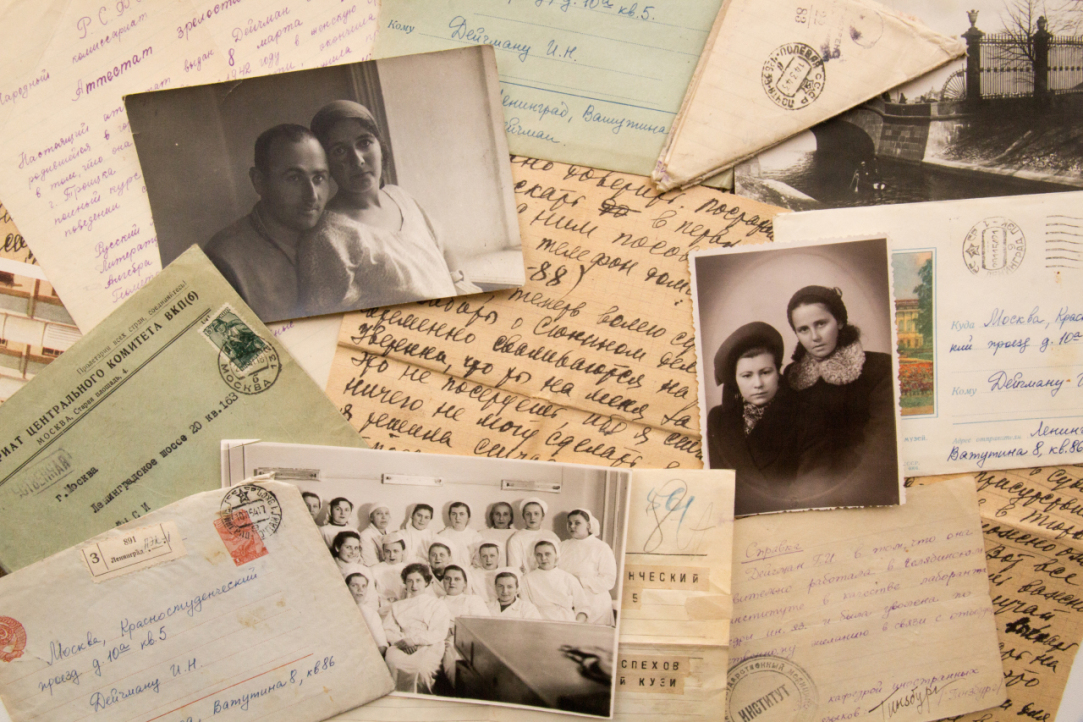
International Centre for the History and Sociology of World War II and Its Consequences, Higher School of Economics and The Friedrich Ebert Foundation held 'A Memory Revolution’: Soviet History Through the Lens of Personal Documents' in Moscow on 7-8 June, 2017. The conference brought together distinguished historians and sociologists from across the globe. Michael David-Fox, Professor of History, Georgetown University, and Academic Advisor of HSE International Center for the History and Sociology of World War II and Its Consequences shares his reflections and considerations on the main topic and discussions at the conference and his own research
Guglielmo Cinque is a professor of linguistics at the University of Venice and one of the most well-known European generativists. Recently he paid a week-long visit the HSE School of linguistics, and now shares his impressions of our students and staff, as well as of this year's weather in Moscow.
On May 31, Valerie Kivelson, Professor of History at the University of Michigan, will be delivering a seminar entitled ‘Visualizing Empire: Muscovite Images of Race’. Professor Kivelson is an expert in Medieval and early modern Russia, history of cartography, history of witchcraft, religion, and political culture, among other topics. She is the author of 'Desperate Magic: The Moral Economy of Witchcraft in Seventeenth Century Russia' and a guest editor of 'Witchcraft Casebook: Magic in Russia, Poland and Ukraine. 15-21st Centuries'.
On May 23, Ellen Rutten, Professor of Russian and Slavic Studies at the University of Amsterdam, delivered a lecture at HSE on her new book, ‘Sincerity after Communism’. An expert on Slavonic literature and culture, Professor Rutten is involved in numerous projects, including the Digital Emotions group, Sublime Imperfections, and ‘Russian Literature’, a journal where she serves as editor-in-chief.
Google announced the recepients of its several scholarship programs, including the Women Techmakers Scholarship (formerly the Anita Borg Memorial Scholarship). Among this year's winners Elizaveta Kuzmenko, 1st year student on the Computational Linguistics MA programme at HSE.
In its 25<sup>th</sup> anniversary year, HSE has marked new achievements, entering the Top 50 in the Times Higher Education (THE) Young University Rankings among universities under 30 years old, and in the Top 100 in the global Young University Rankings under 50. HSE has become the first Russian university to enter the top list of THE Young Universities, a global institutional ranking.
The course is authored and run by the head of the school, prof. Ekaterina Rakhilina.
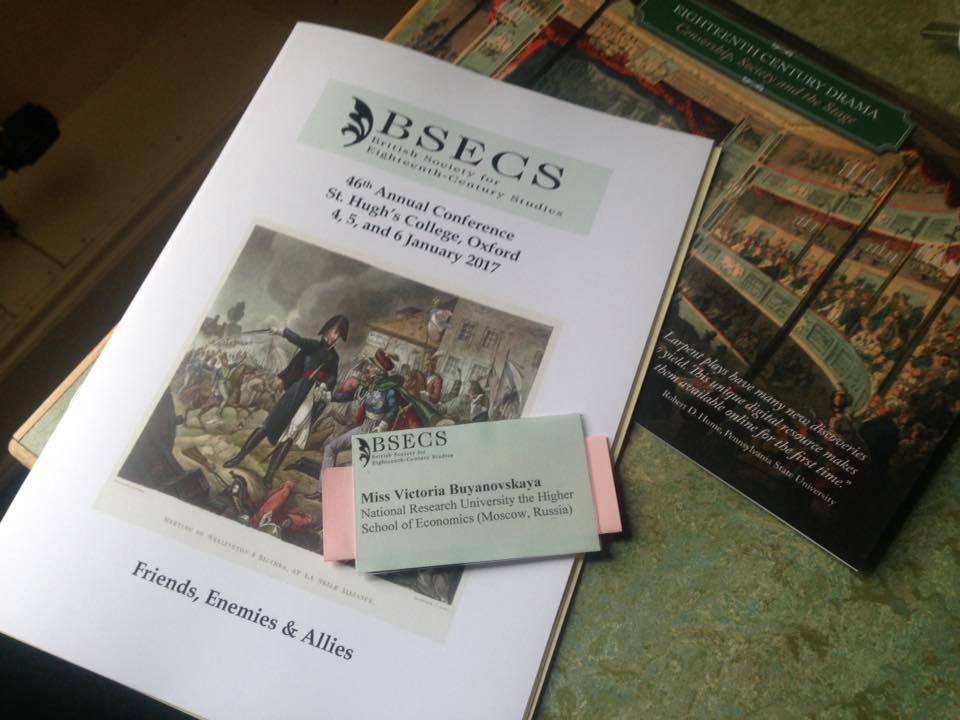
Giving a presentation at a research conference, especially in a different city, and all the more so in a different country, is an important event in the life of any philology student. Viktoria Buyanovskaya, third-year HSE philology student, told us about her presentation at the University of Oxford.
New article by Elena Penskaya, the head of the School of Philolohy, in the Italian academic journal "Enthymema".
2016 marked 125 years since the birth of Osip Mandelstam. Pavel Polian (Nerler), Director of the Mandelstam Centre, summarized the results of its years’ work
Dirk Geeraerts, a professor at the University of Leuven, talks about the advantages of linguistiс training at the Higher School of Econimics, the high level of interaction demonstrated by the students at the School of Linguistics, and the potential upcoming convergence of fundamental and applied linguistic research.
Tilmann Reuther, Professor at the University of Klagenfurt, and his colleague Joulia Köstenbaumer talk to the HSE News Service about their experience of cooperation with the School of Linguistics and internships in Austria.